Case Study: How HoseMaster Applied AI to Automate a Complex RFQ and Order Intake Workflow
From a Noisy Inbox to Structured Order Intelligence
Executive Summary
For HoseMaster, customer demand does not always arrive as clean, structured data.
Requests for quotes and purchase orders flow into a shared sales inbox through emails containing different formats, terminology, attachments, product references, and varying amounts of information. Turning those communications into actionable order data requires staff to interpret what the customer is requesting before the quoting and order-entry process can move forward.
Working within an engagement led by EIS IT Consulting, Cadensoft developed an NLP-powered quoting agent designed to interpret these inbound communications and transform relevant information into structured order data.
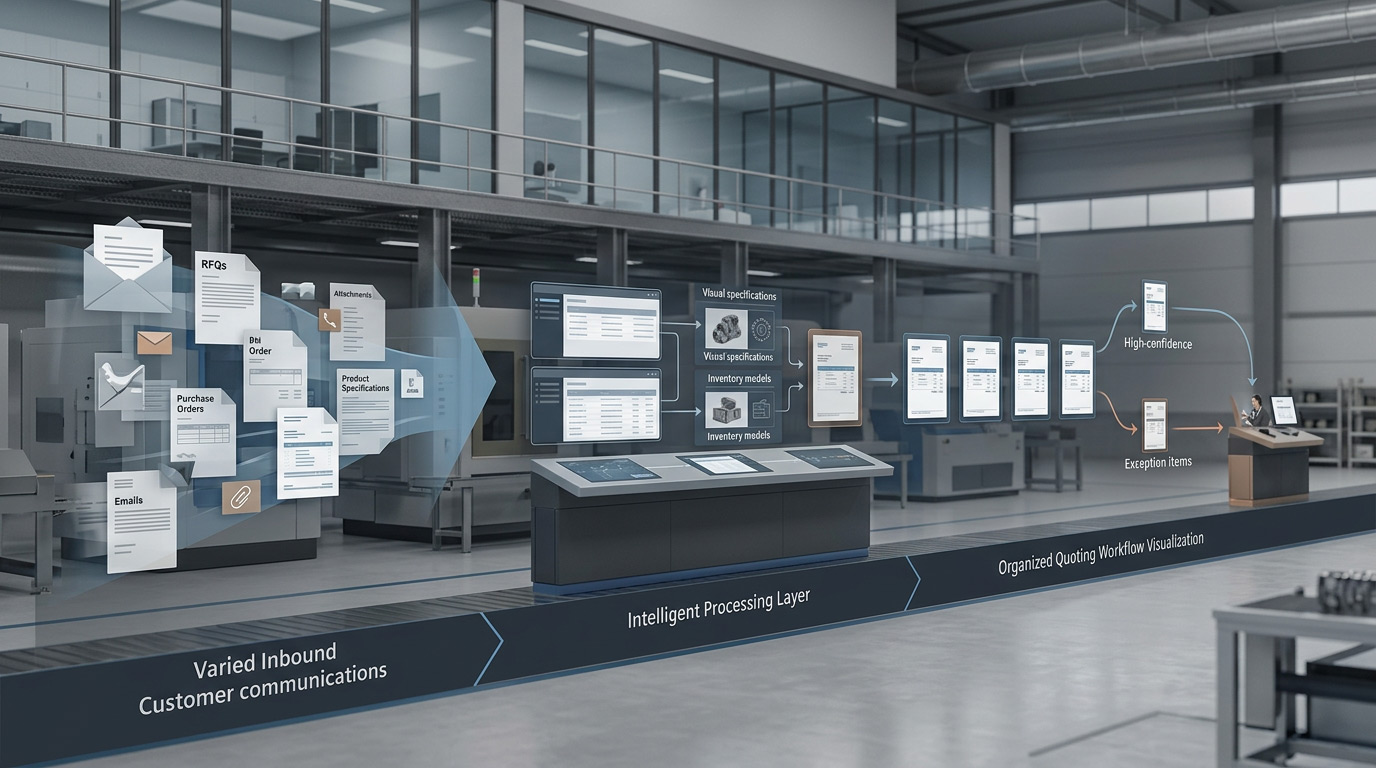
The solution combines large language model processing, retrieval against historical order information, structured output requirements, and a human-in-the-loop review process. High-confidence results can move through an auto-accept workflow while uncertain results are routed for review.
During proof-of-concept operation, the system achieved an approximately 80% success rate identifying orders, demonstrating the potential to automate a significant portion of a workflow previously dependent on manual interpretation.
The result is not simply an AI experiment. It is a working example of how applied AI can begin turning an existing communication channel into a more structured operational workflow.
Client Background
HoseMaster is an industrial hose manufacturer and distributor serving customers whose requirements can involve detailed product specifications and configurations.
Customer RFQs and purchase orders frequently arrive through email, making the shared sales inbox an important entry point into the organization’s quoting and order-processing workflow.
Unlike a structured ecommerce transaction, however, an email does not necessarily arrive in a predictable format.
The information needed to understand an order may exist within the body of a message, attached documents, previous correspondence, customer terminology, or specific product references.
That created an opportunity to determine whether modern natural language processing could interpret those communications reliably enough to reduce the manual effort required to identify and structure incoming orders.
The Challenge
The Inbox Was Designed for Communication, Not Structured Order Processing
Email works extremely well as a communication channel.
It is considerably less predictable as a source of structured operational data.
Inbound communications contained far more information than the quoting process actually required. Relevant product information could be surrounded by signatures, previous correspondence, unrelated text, attachments, customer-specific terminology, and other noise.
The challenge was therefore more complicated than extracting fields from a standardized document.
The system needed to determine what information actually mattered.
It then needed to interpret that information accurately enough to identify the requested products and return the required data in a consistent structure.
Product similarity created an additional challenge. Closely related product variants could produce false-positive matches, requiring the model to distinguish between items whose descriptions or characteristics appeared similar.
The operational objective was not simply to have an LLM read an email.
It was to determine whether AI could become a reliable participant in the quoting workflow.
Why Traditional Automation Wasn’t Enough
Traditional workflow automation works particularly well when inputs are predictable.
An online form, for example, can require a customer to provide specific values in specific fields.
HoseMaster’s existing customer behavior did not provide that structure.
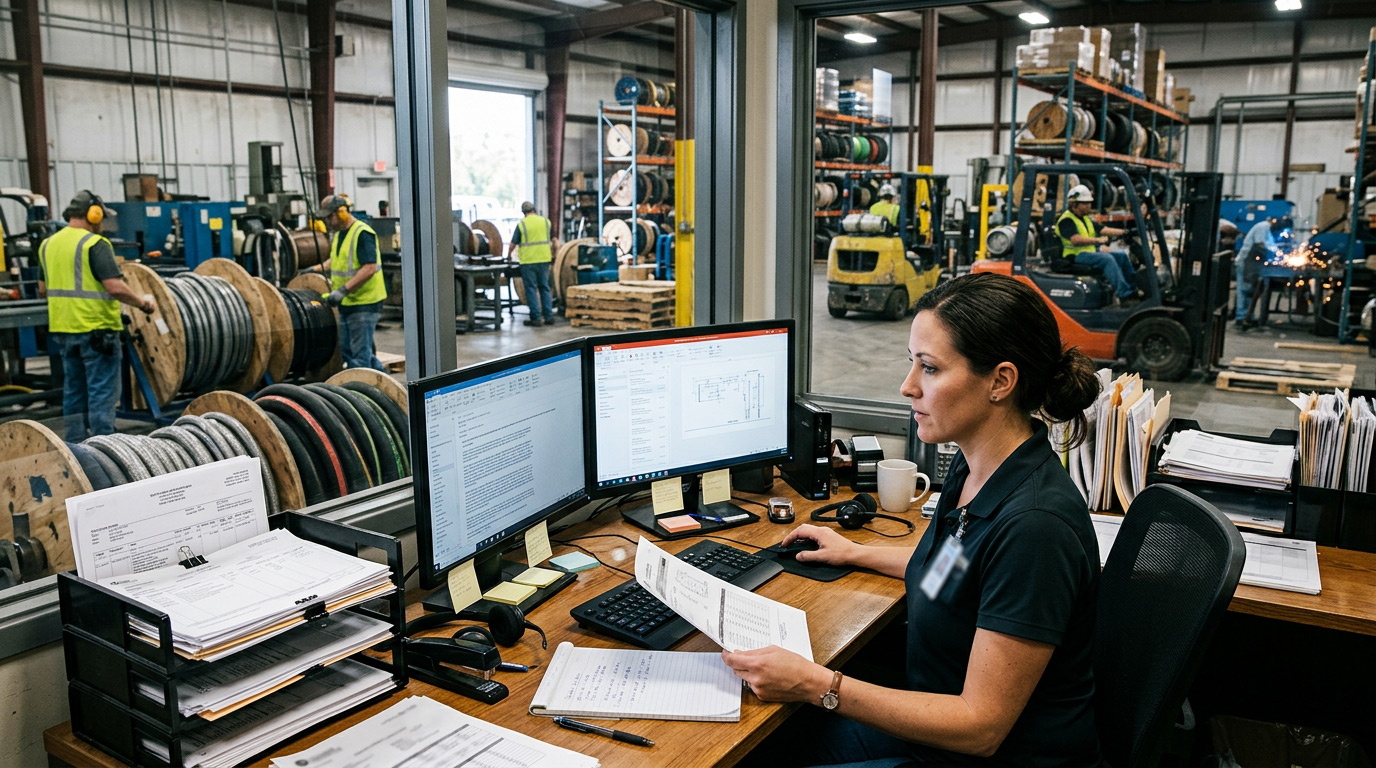
Customers were already submitting RFQs and purchase orders through email, and the content of those communications varied considerably.
Creating value therefore meant working with the information as it actually arrived rather than requiring every customer to adopt a new interaction model.
This made the problem well suited to an NLP and LLM-based approach.
The goal was to create structure from unstructured information while preserving human oversight where the system lacked sufficient confidence.
The Cadensoft Approach
Start With Real Orders
The agent was developed and tested using historical RFQs, purchase orders, sample quotes, and other real-world communications supplied by HoseMaster.
This was important because the variability within actual customer communication quickly exposed challenges that would have been difficult to reproduce with artificially clean test data.
Early testing revealed significant noise within inbound emails, requiring additional filtering and tuning before user acceptance testing.
Rather than treating that as an exception, the workflow was refined around the reality of the data.
Create a Retrieval Layer Around Existing Information
Relevant data was moved from SharePoint into Azure Blob Storage, with Azure AI Search providing retrieval capabilities to support the language model.
This retrieval-augmented generation approach gave the agent access to relevant contextual information when interpreting inbound requests.
The objective was not simply to ask a general-purpose model to guess what a customer intended.
It was to give the model access to relevant business context while constraining its response to a defined operational task.
Define the Output Before Automating the Workflow
Cadensoft worked collaboratively with HoseMaster to define the structured JSON output required from the agent.
This established a consistent data contract between AI interpretation and downstream workflow processing.
Instead of producing free-form AI responses, the model was expected to return specific properties that could be evaluated and used operationally.
That distinction is important.
For AI to participate meaningfully in business operations, its output must ultimately become usable by the systems and people responsible for the next step.
Keep People in the Decision Loop
The solution was deliberately designed around human oversight.
Processed quotes were separated into two paths:
Auto-Accepted
Results with sufficient confidence could progress through the automated workflow.
Pending Review
Items requiring additional validation were surfaced for staff review and correction.
A review interface was also developed to make it easier for HoseMaster staff to inspect processed emails and corresponding quote information.
This created an operational feedback loop.
Instead of requiring the AI to be perfect before creating value, automation could handle higher-confidence work while people concentrated their attention on exceptions.
Strategic Takeaway
The most valuable AI opportunities are often not new workflows.
They are existing workflows where people spend significant time interpreting unstructured information before operational work can begin.
HoseMaster already had a functioning customer communication channel. Customers knew how to submit requests. Staff knew how to process them.
The opportunity was to make the workflow between those two points more intelligent.
By combining NLP, retrieval, structured outputs, confidence-based routing, and human review, Cadensoft demonstrated how AI can begin transforming an inherently unstructured process into a more scalable operational system without requiring customers to change how they communicate.
The proof of concept provides the foundation for the next question: how much further can that operational intelligence be extended?
The result was a more visible, consistent, and scalable revenue operations system.
Project Snapshot
Client
HoseMaster LLC
Industry
Manufacturing & Industrial Distribution
Focus Area
Applied AI & Order Processing Automation
Core Challenge
Transforming unstructured customer emails, RFQs, and purchase orders into reliable structured order information
Solution Type
NLP-Powered Quoting & Order Intake Agent
Capabilities Applied
Applied AI, NLP/LLM Processing, Retrieval-Augmented Generation, Workflow Automation, Human-in-the-Loop Review, Azure Cloud Architecture
Primary Outcome
Approximately 80% success identifying orders during proof-of-concept operation
Project Status
Live Proof of Concept
Find the AI Opportunity Inside Your Existing Workflow
Related Solutions
AI-Powered Solutions
Apply AI and automation where they create meaningful operational leverage.
Explore Applied AI Solutions
Predictable Product Delivery
Structured software delivery with transparent planning and measurable progress.
See How We Build Software Differently
Manufacturing Technology
Improve visibility and coordination across manufacturing information, systems, and operational workflows.
The Solution
The resulting proof of concept created an intelligent processing layer between HoseMaster’s inbound sales communications and its quoting workflow.
The solution included:
Intelligent Email Processing
Retrieval-Augmented AI
Structured Data Generation
Confidence-Based Workflow Routing
Human Review Interface
Environment Deployment
Operational Impact
Approximately 80% Order Identification Success
For an operational workflow driven by highly variable, unstructured customer communication, this provided meaningful validation that a significant portion of incoming work could potentially be interpreted automatically.
Structured Data From Unstructured Communication
This is an important shift.
The inbox remains familiar to the customer while becoming a more intelligent operational input for the organization.
Human Attention Focused on Exceptions
The objective is not eliminating people from the process.
It is using automation to determine where their attention creates the most value.
A Practical Feedback Loop for Continued Improvement
Examples such as false-positive matches between similar product variants helped expose where additional tuning was required.
That feedback creates a path for continued refinement rather than treating initial model performance as a fixed endpoint.
Validation Before Larger-Scale Investment
The engagement established a functioning proof of concept before committing to broader production expansion.
HoseMaster can evaluate how the capability performs against real operational activity, identify where additional integration or refinement is required, and make more informed decisions about the next phase of investment.
Turn Operational Friction Into A More Intelligent Workflow